
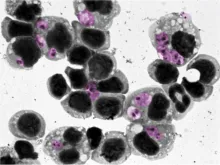
Findings from a new UMD-led study could help doctors select more effective treatments earlier for patients suffering from leishmaniasis, a disfiguring skin infection.

A University of Maryland study reveals an evolutionary trade-off that young plants face to develop disease resistance.

Researchers at the University of Maryland and University of Pennsylvania show proposed NIH funding cuts lead to an estimated $16 billion in economic loss and 68,000 jobs lost nationwide.
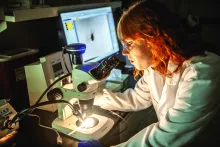
Rachel Lipman is a biological sciences Ph.D. student working in the Department of Veterinary Medicine. Under the guidance of Utpal Pal, she is helping develop a vaccine to prevent Lyme disease, a bacterial infection caused by a bite from an infected black-legged tick, also known as a deer tick.

UMD’s 53 scholarships in the past 16 years rank No. 2 nationwide.

For Adrienne Kish (Ph.D. ’07, cell biology and molecular genetics), dreams of ‘doing biology in space’ are becoming a reality with an upcoming mission to the International Space Station.

A new study co-led by UMD biologist Joshua Weitz found that microbes divvy nutrients over time, reducing competition for limited resources.

The awards will support two research projects co-led by University of Maryland professors Jonathan Simon and Alexander Philippov.

Najib El-Sayed, a professor of cell biology and molecular genetics, is working with Xuan “Anna” Li, an assistant professor of psychology, to uncover genetic and epigenetic changes—how genes are turned on or off—linked to relapse behavior involving oxycodone abuse.

Researchers pursuing collaborative work on pressing issues were awarded $150,000.