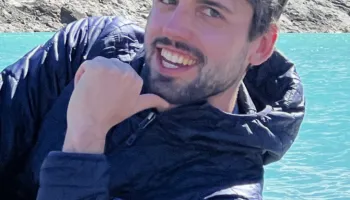
Biological sciences Ph.D. student John Labella channels impressions from a sci-fi bestseller and research experiences in biotech as he develops novel genetic tools and problem-solving technology.
John Labella has two passions: playing music (especially jazz) on the alto saxophone and pushing the boundaries of cellular and molecular biology as a biological sciences Ph.D. student at the University of Maryland.
In music, Labella thrives on the creative energy of collaboration.
“You know, it’s that eureka moment,” Labella said, “that moment when you see beyond the words on the page or the notes in the music, and you feel what it can actually become beyond that. In those moments when everybody is playing together and hitting their mark, you're creating something greater than the sum of your parts, and there's just no feeling like it.”
It’s not unlike the connection he feels doing research in Cell Biology and Molecular Genetics Professor Wade Winkler’s lab at UMD.

“When you hear about what your lab mates are working on, and you can see the connections, how their work relates to what you're doing and how the different components fit together, there is that sort of greater connection in how we’re all working in concert to take on these scientific challenges,” he said. “Everybody’s working together toward a common goal, and that’s exciting,” he said.
Before starting his Ph.D. at Maryland, Labella spent five years in biotech, developing genetic medicines and other novel biotech solutions. Now, through his graduate research, Labella hopes to grow as a scientist and apply what he’s learned about DNA, RNA and related proteins to engineer new disease-fighting therapies and problem-solving technology.
“My scientific interests primarily lie in synthetic biology, both in designing novel genetic tools and subsequently applying them to solve a multitude of problems,” Labella said. “The way I like to describe it is that I’m interested in finding new tools for the toolbox, as well as finding out how to use those tools in different ways. I want to find the best hammer in there and then figure out how it can best be applied.”
From science fiction to real science
Growing up in Trumbull, Connecticut, Labella’s passion for science was inspired by a science fiction thriller—Jurassic Park, the Michael Crichton bestseller about a theme park featuring dinosaurs cloned from prehistoric DNA.
“I think that for me, that book inspired a love of just the fantastical side of science, especially genetics, and the power that it has in terms of actual concrete, realistic science,” Labella said. “The book was written in the ’90s, so it had pretty good accuracy for what was going on at the time, and even though we know a lot more now, it was still a great jumping off point.”
When Labella started his undergraduate studies at Northeastern University in 2013, he knew he wanted to study biology. He was especially interested in a new gene-editing technology—and this time it was fact, not fiction.
“When I was in undergrad, it was right around the time when CRISPR was really starting to take off—this brand new, powerful gene editing tool was suddenly becoming widely available, and everybody was losing their minds over what it could do and how to use it,” Labella recalled. “I think what I really learned is that there's still so much out there that is unknown about what we can use and what can be done just from what already exists in nature. Wanting to discover how that worked and what it could be used for really inspired me.”
An undergraduate work experience at Editas Medicine on the company’s DNA damage and repair team gave Labella hands-on experience with CRISPR-based therapeutics.
“It was at Editas that I really got deeper into the science, and I really got to see the sort of scope of what genetic tools could do,” he said. “I mostly just wanted to use gene editing and this evolving technology to help people fix some of the wide variety of problems facing the world—like, how do we make this technology better?”
After graduating in 2018, Labella worked as an associate scientist at Cyteir Therapeutics, a clinical-stage company focused on developing small molecules to target the genetic components of cancers. Later, he moved on to Tessera Therapeutics, a biotech company focused on fighting disease.
“At Tessera, I was working on improving the platform that the company was using for gene editing and doing work in genetic medicine, testing how well our different constructs, different DNA molecules and designs worked to cause the changes we wanted to see in cells,” he explained. “By the time I left, some of the stuff that I worked on had made its way to clinical trials, which was really rewarding.”
Returning to academia, exceeding expectations
But for Labella, there was still more to learn. Anxious to broaden his research and his gene-editing toolkit, he returned to academia in 2023.
“I applied to Maryland partially because of the science that was being done here,” he said. “A lot of people were doing interesting things in medicine, but also in other labs working with plant genomics and fungal genetics, and I knew this was the best place for me. “
In his research, Labella investigates the mechanics of how RNA works inside cells, specifically a concept called RNA-mediated antitermination, a process in which RNA molecules produce signals that prevent gene expression from stopping prematurely. By better understanding this and other cellular mechanisms, Labella hopes to find ways to modify them and create problem-solving biotechnology.
“We still don't understand a lot of the rules of how DNA regulation works in cells. So, it's kind of like we have the computer, but we don't understand the entire code that goes into it,” he explained. “And if we don't understand the basic rules of how this works, then we can't make those better tools. Learning how the fundamentals work within cells can lead us toward new avenues of research and new approaches for fighting diseases, as well as other environmental or industrial applications.”
When he’s not conducting research, Labella is a teaching assistant for a microbial genetics class that uses some of the cell lines he developed in his work. And he still finds time for music, playing his alto sax in UMD’s Gamer Symphony Orchestra.
“Music is still what I do for fun,” he explained. “It’s great to have that creative outlet, but science is my work, what I devote my day-to-day life to.”
Winkler has been impressed with Labella’s work in the lab from day one.
“John’s progress on his dissertation research has been remarkably rapid since joining my group, reflecting not only his strong work ethic but also the organizational skills he developed through his industry experience,” Winkler noted. “Scientific research also relies heavily on individual creativity, and John’s engagement with creative outlets such as music is likely to enrich his work by fostering an openness to new ideas and unconventional approaches. I look forward to seeing where John takes his research next.”
And when it comes to building his scientific toolkit, Labella says his graduate experience has exceeded his expectations.
“I think grad school is teaching me how to be a scientist in the best way. When I entered UMD, I was kind of a bench scientist, where someone said, ‘Here's your protocol, now go do it.’ I could see how I contributed to the science, but I wasn't the one asking the questions or choosing the best approach,” he explained. “Now I can see myself in that role of making the pivotal research decisions, choosing what’s most important to pursue and understanding how to go after it. In the big picture, I hope I can make or discover something that can be used to improve the world. If I can find something that can improve people’s lives, that’s what I really hope to do.”