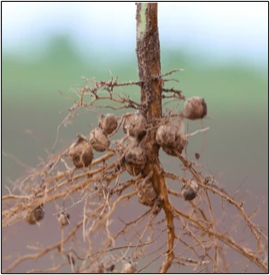
The Maryland Soybean Board estimates that the state of Maryland produces around 16 million bushels of soybeans annually, contributing around $200 million to the state’s economy. However, as climate change continues to alter weather patterns, plant damage caused by plant eating insects (herbivores) and drought-related stressors in some regions threaten crop health and yield, leading to potential challenges for crop production. Soybeans provide a valuable system for investigating the relationships that influence resilience, potentially leading to solutions for higher crop yields when plants are stressed. Soybean plants form a symbiotic relationship with nitrogen-fixing bacteria called rhizobia, which colonize the plant’s roots and form nodules (Figure 1). This relationship is typically mutualistic, meaning that both organisms benefit. Rhizobia create nitrogen for the plants to use for growth and reproduction, while the plant provides the rhizobia with carbon. Though not all rhizobial strains, or specific types of rhizobia, provide the same benefits, differences among rhizobial partners may change how soybeans react to environmental stress.1
At a recent University of Maryland Entomology Colloquium, Dr. Brendan Randall presented his dissertation research exploring how rhizobial strain identity and diversity influence soybean health across environments, especially in response to herbivory and drought. The seminar served as the public portion of his PhD defense, which he completed later that day.
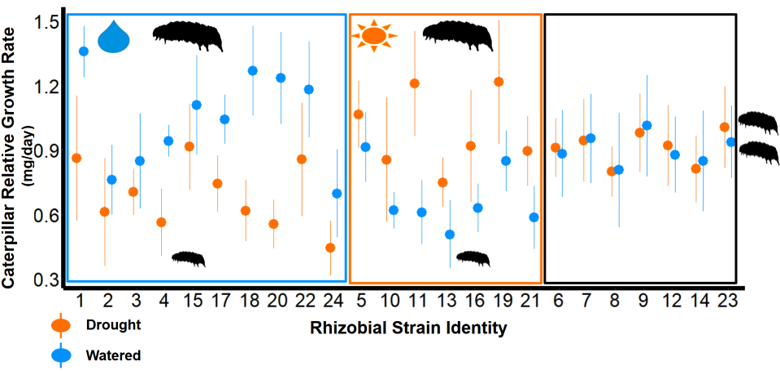
Dr. Randall’s dissertation investigated how the specific rhizobial strain associated with a plant affects the plant’s resistance to herbivory and drought stress. It was found that the type of rhizobia associated with the plant can influence how the plants respond to drought and how suitable they are as food for insects. In a greenhouse experiment, soybean plants inoculated with one of 24 rhizobial strain treatments were grown; the plants were grouped to receive different combinations of water and herbivore treatments. There were four plant groups in the experiment: watered plants that were either exposed to caterpillars or not, and non-watered plants that were either exposed to caterpillars or not. Some strains of rhizobia supported larger herbivores (measured by body size) in drought-affected plants, while other strains supported larger herbivores in watered plants; there were also some strains that didn’t show a difference in the herbivore size between the two watering treatments (Figure 2). While farmers do not want bigger caterpillars, these differences in size mean that the plant’s nutritional value and/or defenses against herbivores likely varied with the strain of rhizobia and climate.
Indeed, multiple plant traits were also measured, including the number of trichomes on the plant. Trichromes are small, hair-like appendages that can act as physical obstacles for insect herbivores. Dr. Randall found that the number of trichomes on the plant changed depending on the rhizobial strain associated with the plant, meaning that trichome expression depends, in part, on the rhizobial strain present. These results suggest that what occurs underground, like the relationships plants have with bacteria, can affect the above-ground portions of the plant.
Next, Dr. Randall wanted to explore how rhizobial strain diversity affects soybean responses to environmental stressors because soybean plants are exposed to potentially dozens of different strains found in the soil. Understanding how different strains interact would be invaluable for farms trying to improve the soybean crops. In this set of greenhouse experiments, each soybean plant was inoculated with either a single strain, two strains, or four strains of rhizobia and then subjected to combined watering and herbivory treatments. While single-strain plants showed a higher caterpillar growth rate in watered plants than the drought-treatment plants, there was little difference between watered and drought-treatment plants in two- and four-strain inoculated plants. This shows that greater rhizobial diversity stabilizes the plant’s response to herbivores in the face of drought-related stress, but not necessarily that increased diversity improves resistance. Additionally, higher strain diversity resulted in increased plant performance so long as the plant was not stressed by herbivory. While single-strain plants showed little difference in above ground growth whether or not they are fed upon by caterpillars, two- and four-strain inoculated plants had increasingly greater biomass under unstressed conditions. These experiments demonstrate that soybean plant growth and performance are impacted by many factors but increasing rhizobial strain diversity can stabilize or improve performance in the face of drought and herbivory.
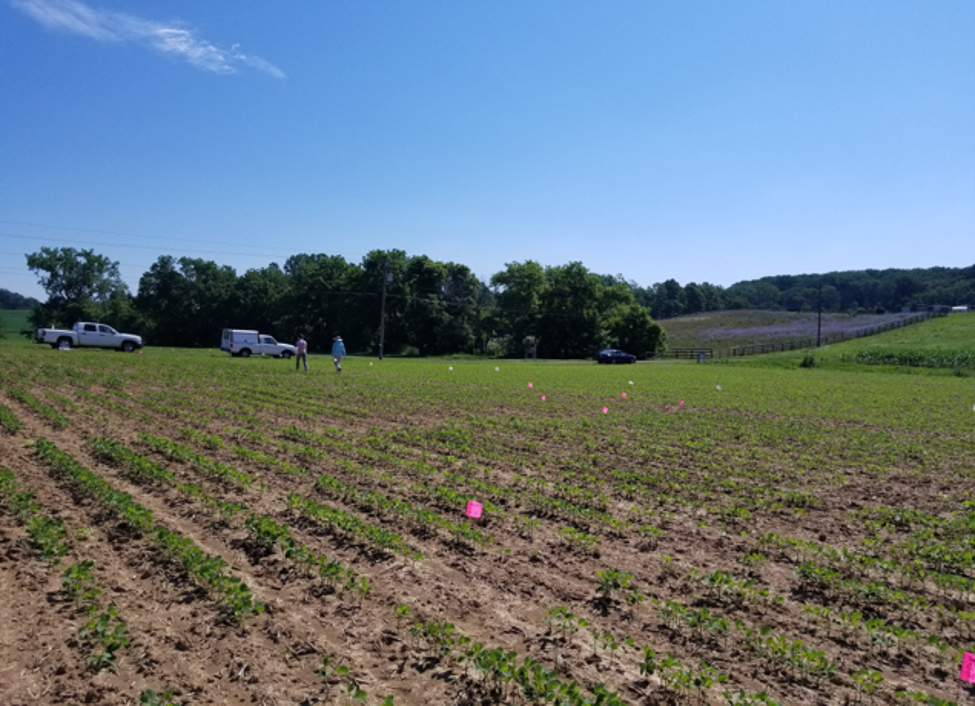
Dr. Randall took his final set of experiments out into the field to see what rhizobial diversity looked like in various soybean fields across the years (Figure 3). Between 2019 and 2022, he looked at four Maryland research farm locations that span different soil types and growing conditions. These farms were growing uninoculated soybeans, allowing him to see which rhizobia in the soil were colonizing the soybean roots. By sequencing rhizobial DNA found in the root nodules, he was able to characterize the diversity of rhizobia, finding that across these farms, soybean nodules are dominated primarily by two strains. By looking at plant growth and herbivory at these farms, he was also able to determine that plants that associated with more rhizobial strains showed higher plant growth, but associating with more strains didn’t provide meaningful resistance to herbivory in the field. Greenhouse and field experiments are both important scientific tools. Greenhouse experiments are valuable because they take place in relatively controlled environments, making them highly reproducible. However, that also means that they are missing the dynamic, interacting environmental factors found in the field, such as variable weather and a broad array of insect species feeding on the plants. So field experiments like this one are important to see if the findings of greenhouse experiments hold true in more complex environments.
The findings of these studies have exciting implications for soybean farming. This new data shows farmers can potentially improve the growth of their plants or stabilize plant growth in the face of drought by choosing an appropriate cocktail of rhizobia strains for their plants. Dr. Randall closed his talk by saying that soybean farmers would likely benefit from coating their seeds with mixed strains of rhizobia to provide increased stability and robustness in their crop outcomes. He also noted there is further research required to explore the incredible diversity of rhizobia worldwide and how that diversity would interact with more genetically diverse soybean varieties grown elsewhere in the world.
Authors:
Makala Harrison is a master’s student in the Department of Entomology. Her research in the Shultz lab is focusing on a taxonomic revision of North American harvestmen.
Daniel Davis is a PhD student in the UMD Department of Entomology. His research in the Fritz Lab focuses on the evolution of Bt-resistance in corn earworms.
Sources:
1 Randall, B. A., Komatsu, K. J., Parker, J. D., McGurrin, K., Alley, S. J. M., Hearn, C. T., & Burghardt, K. T. (2025). Microbial partners drive legume trait plasticity and tripartite interaction outcomes under combined stress environments. bioRxiv. https://doi.org/10.1101/2025.10.02.678283