
Cenk Sahinalp
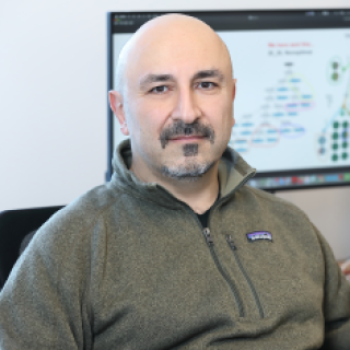
Cenk Sahinalp
A long-time focus of my lab has been discovery and interpretation of large-scale genomic and transcriptomic alterations in tumor cells. Our algorithmic methods for genomic structural variation discovery, including VariationHunter, CommonLAW, DeStruct and NovelSeq, were the first with the ability to handle novel insertions, deletions, inversions and duplications in repetitive regions of the human genome. I am currently interested in applying our algorithmic techniques to exact genotyping of highly repetitive, structurally variant genes. These include genes involved in drug metabolism – for which my group has developed Cypiripi and Aldy methods, and the immune system genes for which my group has developed Immunotyper and Geny methods. My lab has also contributed to the identification and quantification of transcriptomic aberrations, in particular gene fusions, as well as genic inversions, duplications and deletions in cancer samples. Leading computational methods we have developed include DeFuse, NFuse, Comrad MiStrVar and SVICT (which handles circulating cell-free tumor DNA data).
Our current focus area is tumor heterogeneity and progression inference, especially by the use of single-cell sequencing and spatial/time series sequencing (for which we have developed CITUP, CTP-Single, Remix-T, BSCITE, PhISCS, CONETT, PhISCS-BnB, DeepT, HUNTRESS, Sgootr, Detopt and others). We have also worked on network-aided, integrative analysis of genomic and transcriptomic sequence data from tumor samples (Hit’nDrive and cdCAP). We have several additional interests within "algorithmic biology" including (i) read alignment and variant calling (e.g. for reads from repetitive regions of the genome – mrFAST, mrsFAST, drFAST and lordFAST, or reads extracted from cell free tumor DNA - SINVICT), (ii) genomic data compression (SCALCE, DeeZ and AssemblTrie), (iii) secure/privacy preserving genomic sequence analysis (PrivStrat, SkSES, SMac, TX-Phase) and (iv) metagenomic binning (CAMMiQ).
Latest Papers
Chimeric antigen receptor T cells against the IGHV4-34 B cell receptor specifically eliminate neoplastic and autoimmune B cells
|
Science Translational Medicine
Author(s): Alessia Santi, Robert J Kreitman, Giorgio Inghirami, et. al
UMD Author(s): Cenk Sahinalp
GenCore: Genomic distance estimation using Locally Consistent Parsing
Author(s): Akmuhammet Ashyralyyev, Ege Sirvan, Ecem İlgün, et. al
UMD Author(s): Cenk Sahinalp
Secure phasing of private genomes in a trusted execution environment with TX-Phase
|
Genome Research
Author(s): Natnatee Dokmai, Kaiyuan Zhu, S. Cenk Sahinalp, et. al
UMD Author(s): Cenk Sahinalp
Fair molecular feature selection unveils universally tumor lineage-informative methylation sites in colorectal cancer
|
Bioinformatics
Author(s): Xuan Cindy Li, Yuelin Liu, Alejandro A Schäffer, et. al
UMD Author(s): Cenk Sahinalp
Big data in basic and translational cancer research
|
Nature Reviews Cancer
Author(s): Peng Jiang, Sanju Sinha, Kenneth Aldape, et. al
UMD Author(s): Cenk Sahinalp
Strain level microbial detection and quantification with applications to single cell metagenomics
|
Nature Communications
Author(s): Kaiyuan Zhu, Alejandro A. Schäffer, Welles Robinson, et. al
UMD Author(s): Cenk Sahinalp
CYP2C8, CYP2C9, and CYP2C19 Characterization Using Next-Generation Sequencing and Haplotype Analysis
|
The Journal of Molecular Diagnostics
Author(s): Andrea Gaedigk, Erin C. Boone, Steven E. Scherer, et. al
UMD Author(s): Cenk Sahinalp