Daniel Butts
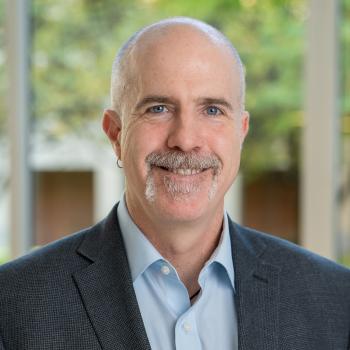
Daniel Butts
Teaching
- BSCI 353: Principles of Neuroscience / NEUR 306: Cellular and Molecular Neuroscience
- NACS 643: Computational Neuroscience (NACS 643)
- NACS 728H: Neural Coding (intermittent)
Graduate Program Affiliations
- Applied Mathematics & Statistics, and Scientific Computation (AMSC)
- Biological Sciences (BISI): Computational Biology, Bioinformatics, and Genomics (CBBG)
- Biological Sciences (BISI): Physiological Systems (PSYS)
- Biophysics (BIPH)
- Neuroscience & Cognitive Science (NACS)
Research Interests
As we look at the world around us, we have immediate access to the composition of the visual scene into objects, as well as our relationship in space to those objects. This natural facility makes it possible to move though the world, catch or avoid moving objects, and base immediate decisions on a detailed understanding of the world around us. Only secondarily might we note the particular color or composition of particular points in the visual scene, or the angle between two contours resulting from one object partially occluding another, or other low-level visual features of the scene. Our brain processes vision much differently than computers do: a computer can easily store the hue and luminance of every pixel of an image, but – even with the best available software – it cannot parse an arbitrary natural image into its underlying elements.
However, in the absence of larger conceptual theories of how the brain processes information, established techniques have revolved around studying sensory systems’ abilities to represent information – rather than understand the computation that it performs. In order to study computation in the brain, it is necessary to both establish larger theories about what is being computed, and design experiments to link these larger theories to observable physiology.
Research in the NeuroTheory Lab is concerned both with developing larger theories of system-level function in the visual and other sensory systems, as well as working closely with neurophysiologists to design and perform experiments that can guide and/or validate these theories. As a necessary third goal, we also develop new analytical tools to facilitate these new experiments, as well as increase what can be learned from existing experiments.
Education
- Ph.D., Physics, UC Berkeley, 2000
- B.A., Oberlin College, 1994
All Publications


Latest Papers
Behavioral modulations can alter the visual tuning of neurons in the mouse thalamocortical pathway
|
Cell Reports
Author(s): Karolina Z. Socha, João Couto, Matthew R. Whiteway, et. al
UMD Author(s): Daniel Butts
Running modulates primate and rodent visual cortex differently
|
eLife
Author(s): John P Liska, Declan P Rowley, Trevor Thai K Nguyen, et. al
UMD Author(s): Daniel Butts
Activity in primate visual cortex is minimally driven by spontaneous movements
|
Nature Neuroscience
Author(s): Bharath Chandra Talluri, Incheol Kang, Adam Lazere, et. al
UMD Author(s): Daniel Butts
Detailed characterization of neural selectivity in free viewing primates
|
Nature Communications
Author(s): Jacob L. Yates, Shanna H. Coop, Gabriel H. Sarch, et. al
UMD Author(s): Daniel Butts
Hierarchical VAEs provide a normative account of motion processing in the primate brain
|
Thirty-seventh Conference on Neural Information Processing Systems
Author(s): Hadi Vafaii, Jacob L. Yates, Daniel A. Butts
UMD Author(s): Daniel Butts
Model-based characterization of the selectivity of neurons in primary visual cortex
|
Journal of neurophysiology
Author(s): Felix Bartsch, Bruce G. Cumming, Daniel A. Butts
UMD Author(s): Daniel Butts
Decision-related feedback in visual cortex lacks spatial selectivity
|
Nature Communications
Author(s): Katrina R. Quinn, Lenka Seillier, Daniel A. Butts, et. al
UMD Author(s): Daniel Butts
A latent variable approach to decoding neural population activity
Author(s): Matthew R Whiteway, Bruno Averbeck, Daniel A Butts
UMD Author(s): Daniel Butts
Data-Driven Approaches to Understanding Visual Neuron Activity
|
Annual Review of Vision Science
UMD Author(s): Daniel Butts
The quest for interpretable models of neural population activity.
|
Current Opinion in Neurobiology
UMD Author(s): Daniel Butts