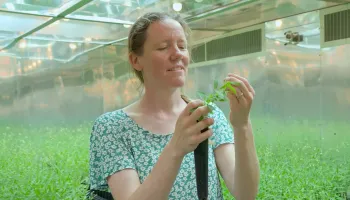
Emily Bruns

Emily Bruns
Biography
My interest in plant disease ecology was sparked as an undergraduate at UC Santa Cruz, working in the lab of Dr. Ingrid Parker. I went on to do a Ph.D. with Dr. Georgiana May at the University of Minnesota, studying constraints to virulence evolution in the fungus causing oat crown rust disease. After graduate school, I did a postdoc with Dr. Janis Antonovics at the University of Virginia, studying disease dynamics at species range limits in the Alps. This is where I first fell in love with 'anther-smut' disease, the model organism my lab studies, and arguably one of the coolest fungal plant diseases out there. I started my lab in the Department of Biology at the University of Maryland in January 2020.
Graduate Program Affiliation
- Biological Sciences (BISI): Behavior, Ecology, Evolution & Systematics (BEES)
Research Interests
Research in my lab focuses on the ecological and evolutionary dynamics of infectious disease in natural populations. A deeper look at any natural ecosystem, community or indeed individual will find it teeming with potentially harmful, disease-causing microbes. How do hosts manage to persist and thrive in spite of this pathogen pressure? This simple, yet classic question is the driving force behind my lab’s research. I find the fundamental tension underlying host-pathogen coexistence fascinating because forces on both sides have the potential to drive the other to extinction. This coexistence involves not just ecological forces, but also rapid, ongoing evolutionary change. At the heart of our lab’s work is the study of disease dynamics in natural plant populations. Plants form the basis of all terrestrial ecosystems, and an understanding of how they persist in the face of both endemic and novel pathogens is essential for both agriculture and conservation, especially in a rapidly changing world. Plants are also a remarkable model system for disease ecology, consisting of hosts that can be easily manipulated experimentally in the field and lab to test fundamental ideas in disease ecology and evolution.
Education
- B.S. University of California, Santa Cruz
- Ph.D. University of Minnesota
- Postdoctoral Training: University of Virginia
Recent Publications
- Bruns, E., Miller, I., Hood, M., Carasso, V., and J. Antonovics. 2019. The role of infectious disease in the evolution of females: evidence from anther-smut disease on a gynodioecious alpine carnation. Evolution. 73: 497-510.
- Bruns, E., Antonovics J., and M.E. Hood. 2019. Is there a disease-free halo at species range limits? The co-distribution of anther-smut disease and its alpine host species. Journal of Ecology. Early View. 2019; 107: 1– 11
- Ashby, B. and E. Bruns. 2018. The evolution of juvenile susceptibility to infectious disease. Proceedings of the Royal Society, B. 285: 20180844.
- Bruns, E., Hood, M.E., and Antonovics, J. 2017 Transmission and temporal dynamics of anther-smut disease (Microbotryum) on alpine carnation (Dianthus pavonius). Journal of Ecology, 105: 1413-1424.
- Miller, I. and E. Bruns. 2016 The effect of disease on the evolution of females and the genetic basis of sex in populations with cytoplasmic male sterility. Proceedings of the Royal Society, B. 283: 20153035.
Latest Papers
Bridging plant pathology and disease ecology: emerging insights into wild plant–pathogen systems
|
Philosophical Transactions B
Author(s): Rachel M. Penczykowski, Remco Stam, Fletcher W. Halliday, et. al
UMD Author(s): Emily Bruns
Contrasting sensitivities to seasonal warming among co-occurring diseases
|
Philosophical Transactions B
Author(s): Sofia Taberski, Emily L. Bruns, Janis Antonovics, et. al
UMD Author(s): Emily Bruns
Do plant pathogens prefer seedlings? Variation in age-specific infectivity across pathogen genotypes
|
Philosophical Transactions B
Author(s): Samuel Slowinski, Eirena Li, Hailey Love, et. al
UMD Author(s): Emily Bruns
Pathogens pull hardest in the coevolutionary arms-race to determine age-specific transmission biases
Author(s): Samuel V. Hulse, Emily L. Bruns
UMD Author(s): Emily Bruns
Disease resistance is more costly at younger ages: An explanation for the maintenance of juvenile susceptibility in a wild plant
|
Proceedings of the National Academy of Sciences
Author(s): Samuel P. Slowinski, Allyson K. Kido, Laura W. Alexander, et. al
UMD Author(s): Emily Bruns
Correction: ‘The emergence of nonlinear evolutionary trade-offs and the maintenance of genetic polymorphisms’ (2024), by Hulse and Bruns
|
Biology Letters
Author(s): Samuel V. Hulse, Emily L. Bruns
UMD Author(s): Emily Bruns
The emergence of nonlinear evolutionary trade-offs and the maintenance of genetic polymorphisms
|
Biology Letters
Author(s): Samuel V. Hulse, Emily L. Bruns
UMD Author(s): Emily Bruns
Measuring Heat Tolerance in a Sterilizing “Anther‐Smut” Pathogen of Wild Plants
|
The Bulletin of the Ecological Society of America
Author(s): Dalia V. Chen, Samuel P. Slowinski, Allyson K. Kido, et. al
UMD Author(s): Emily Bruns
High temperatures reduce growth, infection, and transmission of a naturally occurring fungal plant pathogen
|
Ecology
Author(s): Dalia V. Chen, Samuel P. Slowinski, Allyson K. Kido, et. al
UMD Author(s): Emily Bruns
The Emergence of Non-Linear Evolutionary Trade-offs and the Maintenance of Genetic Polymorphisms
Author(s): Samuel V. Hulse, Emily L. Bruns
UMD Author(s): Emily Bruns