Evolutionary biologist, author and film producer Sean B. Carroll believes that science is best communicated through stories that stick.
Sean B. Carroll studies how new things evolve, focusing on the processes that give rise to surprising new traits and inspiring life forms. The University of Maryland (UMD) Distinguished University Professor of Biology also produces movies and writes books for the public about science. For him, the nitty-gritty of lab research feeds his communication endeavors.
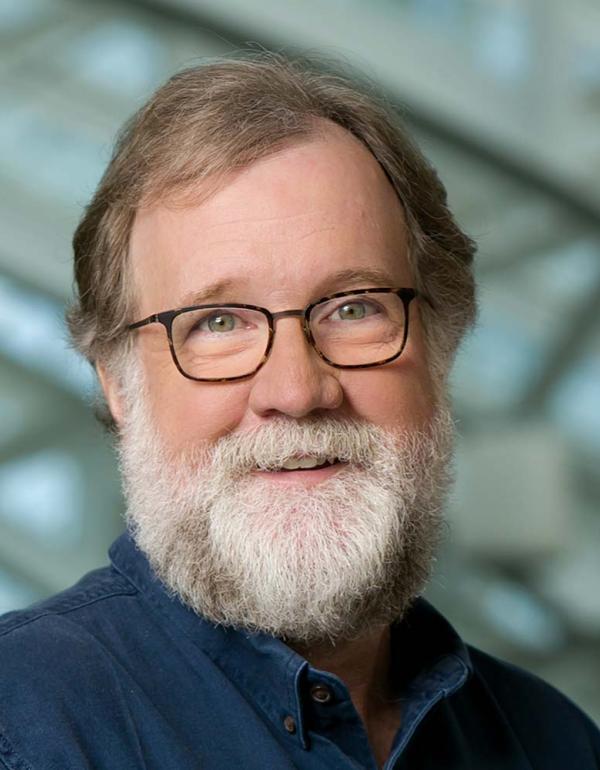
“The two go hand in hand,” said Carroll, who also holds the Andrew and Mary Balo and Nicholas and Susan Simon Endowed Chair at UMD.
Carroll, who joined UMD in 2018, previously led science education at the Howard Hughes Medical Institute (HHMI) (2010-23) and launched and directed the institute’s Tangled Bank Studios (2012-23). He has executive-produced more than 30 films, including recently “Wilding” (2026) and the giant screen film “Blue Whales: Return of the Giants,” and his work has received three Emmys, a Peabody Award and an Oscar nomination. He also authored six highly acclaimed books, including his most recent, “A Series of Fortunate Events: Chance and the Making of the Planet, Life, and You” and “The Serengeti Rules.”
In the following interview with UMD’s College of Computer, Mathematical, and Natural Sciences, Carroll discusses how the best science communication, in any format, has human stories at its heart.
This interview has been edited for length and clarity.
What advantages are there to being both a scientist and a public communicator?
The lab work gives me an insider’s deep understanding of the process of doing science—generating ideas and the detective work and the gamut of emotional experiences it brings, including excitement, doubt, failure and triumph. I think that first-hand experience gives me insights into how to tell the stories of other scientists.
The challenge is that science is often unfamiliar—potential audiences come to it with different interests and levels of understanding. Science has its own vocabulary, and you may be trying to explain things that are literally invisible.
But for any experience, for any audience, story is the next best thing to being there. For science, for most audiences, story is the only way of being there. Meanwhile, scientific discovery leads to things that affect everyone’s quality and quantity of life—in agriculture, medicine, engineering and technology. It also promotes a life-enriching perspective. We’ve learned mind-blowing things about our world and ourselves in just the last 50 years, and everyone should have access to that understanding.
Talk about your film experience.
I’ve helped make over 50 films—many feature-length but also shorts and series—in a variety of roles, from on-screen presenter to writer to executive producer. We started Tangled Bank Studios at HHMI because we wanted the guiding force to be a science and education organization instead of a broadcast one. We have the privilege of understanding the scientific process and having access to the scientific community, which helps us to judge what’s most important. My intention was always to make powerful films that are entertaining but also have important substance.
In teaching science through the documentary format, what works best?
Characters are essential.
There’s a long tradition of telling science stories through talking heads to make them “educational,” without offering the backstory of the people, their successes and failures. But it’s so much more compelling and effective to show and tell human stories, especially if they’re about science in progress.
Also, many scientists tend to overemphasize the value of textbook information versus the emotional aspect of being a scientist. But focusing on narrative doesn’t mean oversimplifying or fudging things—the science in our films is rigorous and carefully vetted. Emphasizing characters, their high-stakes work, their deep commitment to questions that matter—that’s how you tell stories that stick.
What’s an example of a film you’ve done that “stuck” and what made it sticky?
Many documentaries are narrated over beautiful imagery, with no people. But when we worked with PBS on “The Serengeti Rules,” we had five scientists whose stories formed the foundation of the film. The audience really connected with the people, their wants, fears, setbacks and triumphs. You don’t necessarily get that in a traditional nature film where you’re following animals. There may be heartbreak and triumph, but you’re a bit distant from it.
Documentaries are very much a team enterprise. Science is collaborative. Filmmaking is uber-collaborative. You have scientists, journalists, independent scientific advisers, editors, cinematographers and composers—so many talents and experiences coming together. Our films have succeeded because we know that storytelling, cinematography and music are all incredibly important. If you want to the audience something, you have to make it an enjoyable experience or you’ll lose them.
What are your thoughts on how social media and artificial intelligence (AI) are affecting our understanding of science?
These are complex issues. Simply, if a producer has good content and good intent, people can get a little bite of something valuable in 90 seconds, and the algorithm can feed them more. That could be a good thing. But if the purpose is misinformation or disinformation, then you’re jamming the world with garbage. AI is then learning from that garbage, which is very concerning.
Fifty years ago, the public trusted a few key organizations, like National Geographic, to present the best information available. Now there’s no barrier to entering the arena, which is both a blessing and a curse, especially when it comes to trust in science.
Regarding AI: No doubt it can be a useful tool for communication and inspiration, but it can also be used destructively. I worry that the actual real estate where science communication happens is shrinking, which means there’s less robust content for AI to learn from. It’s a problem without an immediate solution.
What stories are most important to tell right now?
The most important thing is to show the process of science, science in action. The best stories are vehicles for doing that. Science is detective work, and mystery is one of the greatest storytelling genres.
It’s also important to convey that science is a systematic search for as close as we can get to the truth. It’s always being tested against new evidence and scrutinized by the scientific community. It’s a process of truth-testing. I want to tell stories fueled by that vigilance but that give people a glimpse of the joy of the enterprise, the thrill of discovery and the power of the process.
What have been some of your favorite film projects?
In “The Serengeti Rules,” based on one of my books, the filmmakers were able to bring scientists’ stories to life in a way you just can’t do on the page. When I saw early segments about the individual scientists, I said, “You are going to make scientists cry.” They captured, in such a powerful way, what makes us do what we do.
Another great project was “All That Breathes.” It was going to be a little film about two brothers in Delhi rescuing birds, giving us some insight into urban ecology. Compared with “The Serengeti Rules”—about the Serengeti, the Arctic, South America—"All That Breathes” was tiny in scope, but that intimacy was its power. People loved the film intensely. With that smaller scope came human connection you might not get with a traditional documentary.
My experience tells me people are thirsty not just for information but for powerful stories. Stories with hope that show what is possible. I think it’s fair to say that hope and story are what connect us as human beings.